
What Are the Top Lead Apron Types in 2026?

In 2026, choosing a lead apron requires more than comparing thickness or price. Hospitals now examine protection, weight, flexibility, cleaning, and long-term durability. The right apron should match the procedure, exposure pattern, and staff member’s daily workload.

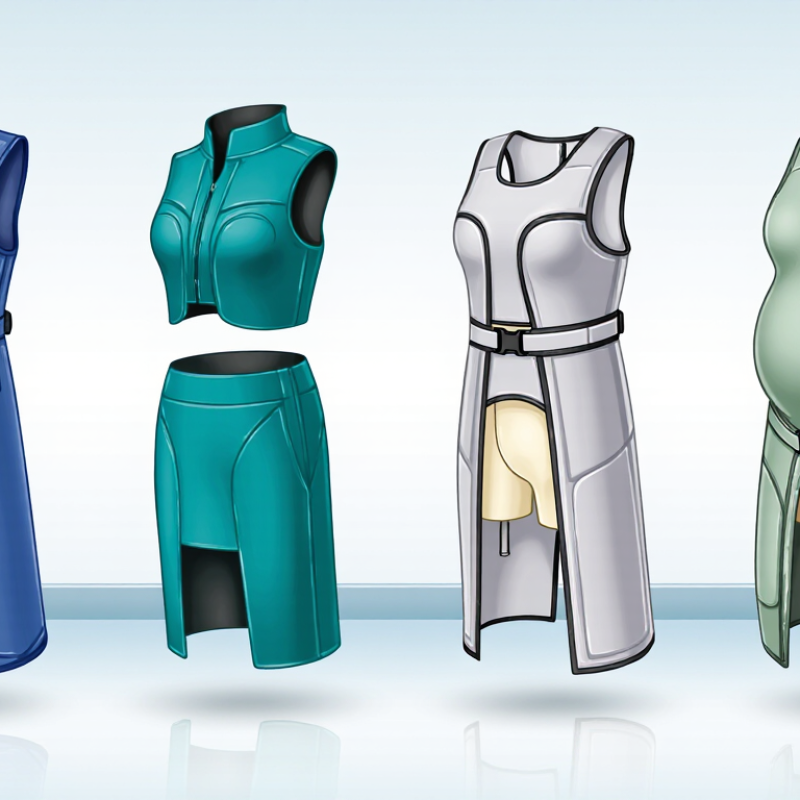
Medical physicist Dr. J. Anthony Seibert has emphasized, “The best protection is time, distance, and shielding.” That principle still guides modern fluoroscopy practice. A wraparound lead apron offers stronger front-and-back coverage during changing work positions. A vest-and-skirt design can distribute weight across the hips. Lightweight, lead-free composites may reduce strain, but they are not automatically better. Their tested equivalence matters.

Fit matters greatly.

An apron that hangs loosely can expose the shoulders and sides. A poorly balanced apron may also cause fatigue during long procedures. Thyroid collars provide added protection near the neck, while maternity designs offer more space without replacing careful positioning. Staff should inspect aprons for cracks, creases, or damaged fasteners. Never fold them sharply. Store them flat or on suitable hangers.

The honest complication is that no single lead apron type fits every clinical setting. Some lightweight materials feel cooler, yet they may cost more or age differently. Some users prefer full wraparound coverage, while others need maximum mobility. This guide compares the leading apron types, their practical strengths, and their limitations. It also considers fit testing, manufacturer documentation, and inspection routines, so buyers can make safer, evidence-informed decisions rather than relying on marketing claims.
What Are the Top Lead Apron Types in 2026?

Lead-Equivalent Ratings: How IEC 61331-3 Defines 0.25, 0.35, and 0.50 mm Pb Aprons

In 2026, the useful question is not simply, “How thick is the apron?”

IEC 61331-3 provides a testing and marking framework for protective clothing. A 0.25 mm Pb apron is lighter, but offers less attenuation than 0.35 or 0.50 mm Pb. These values describe tested equivalence, not actual lead thickness. That distinction matters.

For routine radiography, 0.25 mm Pb may suit lower-scatter tasks and shorter exposures. Fluoroscopy and interventional procedures often justify 0.35 or 0.50 mm Pb near the patient. However, IEC 61331-3 does not prescribe one universal apron rating.

NCRP Report 147 lists 0.1 mGy per week as a controlled-area shielding design goal. It lists 0.02 mGy per week for uncontrolled areas. These figures concern room shielding, not direct apron selection.

Confusing them is an easy mistake.

A reliable review should check conformity marking, test conditions, size, overlap, and declared Pb equivalence. Fit is practical protection. A front-only 0.50 mm panel may leave the sides exposed during oblique fluoroscopy. Wraparound designs improve coverage, but add weight and heat.

The IAEA’s SSG-46 guidance emphasizes optimization, distance, time, and shielding, rather than clothing alone. ICRP Publication 118 identifies a 0.5 Gy threshold for radiation cataracts, reinforcing the need for broader protection.

Aprons also require routine inspection. Cracks, creases, and poor storage can undermine stated performance. A rating is evidence, not a guarantee.

The honest answer is less convenient: the best apron depends on procedure, workload, posture, and fit.

Front-Protection Aprons: Comparing 0.25 mm and 0.35 mm Pb-Equivalent Designs

What Are the Top Lead Apron Types in 2026?

Front-Protection Aprons: Comparing 0.25 mm and 0.35 mm Pb-Equivalent Designs

Front-protection aprons remain common in fluoroscopy, dental imaging, and interventional procedures. Their stated lead equivalence describes attenuation performance at specified radiation energies, not simple material thickness. A 0.25 mm Pb-equivalent apron usually feels lighter and allows easier movement. It may suit shorter procedures with lower scatter exposure. However, protection depends on exposure settings, distance, procedure length, and correct positioning.

A 0.35 mm Pb-equivalent design provides greater attenuation across relevant testing conditions. The trade-off is noticeable weight, especially during long procedures or while standing. A heavier apron can cause shoulder strain when its fit is poor. That detail is easy to underestimate. Front-only protection also leaves the back less protected, so staff should avoid turning away from the radiation source.

Selection should follow a workplace risk assessment, not a thickness preference. A qualified medical physicist or radiation-safety professional can review procedure data and local requirements. Check the apron for cracks, folds, damaged seams, and uneven support. Store it flat or on a suitable hanger; careless folding can weaken protective materials. The best design is the one that staff consistently wear correctly. That assumption deserves review, because comfort and protection are closely connected.

What Are the Top Lead Apron Types in 2026?

Front-Protection Aprons: Comparing 0.25 mm and 0.35 mm Pb-Equivalent Designs

A 0.35 mm Pb-equivalent front-protection apron provides a 40% higher nominal lead-equivalent thickness than a 0.25 mm design. Actual attenuation depends on X-ray energy, beam angle, apron construction, fit, and applicable testing standards; Pb-equivalent thickness should not be treated as a direct percentage reduction in dose.

Wraparound Aprons: When 0.35 mm Front and 0.25 mm Back Protection Matters

What Are the Top Lead Apron Types in 2026?

Wraparound aprons are increasingly chosen for procedures involving frequent movement around imaging equipment. Their 0.35 mm front and 0.25 mm back protection create a practical balance between coverage and weight. The thicker front panel faces the primary scatter direction during many examinations. The lighter back section reduces strain while still supporting rear protection. It is a thoughtful design, not a universal answer.

Fit matters more than many buyers expect. An apron that hangs open at the sides can leave gaps near the ribs and waist. Overlapping front panels should sit smoothly without pulling at the shoulders. During a long fluoroscopy session, poor weight distribution may cause back, neck, or shoulder discomfort. A wraparound model should allow natural movement, especially when staff turn, lean, or reach across the table.

Details matter here.

Lead-equivalent values should be checked against workplace requirements and applicable safety standards. Protective clothing also needs regular visual inspection. Look for creases, cracks, thinning areas, or damaged fasteners. Never fold the apron tightly for storage. Hang it on a suitable support instead. A heavier apron may feel safer, but that assumption is incomplete. Protection, fit, movement, and inspection work together. Even the best specification cannot correct careless handling or an incorrect size.

What Are the Top Lead Apron Types in 2026? – Wraparound Aprons: When 0.35 mm Front and 0.25 mm Back Protection Matters

Evaluation Dimension Typical Wraparound Specification Why It Matters Practical Selection Guidance
Front Protection 0.35 mm lead equivalent Provides the primary shielding across the chest and abdomen, where occupational exposure is commonly managed during diagnostic X-ray and fluoroscopy procedures. Suitable when the wearer may remain near the patient or X-ray field for repeated procedures, subject to the facility’s radiation-protection program.
Back Protection 0.25 mm lead equivalent Offers rear coverage while reducing material compared with a fully 0.35 mm design. Useful for staff who need wraparound coverage and frequently turn, bend, or move around the imaging table.
Coverage Pattern Front overlap with protection extending around the sides and back Helps reduce gaps that can occur with a simple front-only apron, especially during angled or mobile work positions. Check that the front panels overlap fully when fastened and that the sides and back remain covered during normal movement.
Radiation Protection Rating Nominal lead-equivalent values stated in millimetres of lead (mm Pb) Lead equivalence is the recognized way to describe attenuation performance; actual attenuation also depends on X-ray energy, beam quality, construction, and testing method. Verify the garment’s label, conformity documentation, and applicable local or national requirements before purchase.
Typical Applications Fluoroscopy, interventional imaging, mobile radiography, and other occupational diagnostic X-ray settings These environments may involve longer procedures, repeated exposures, or close positioning to the patient. Use a wraparound design when staff movement and side or rear exposure are realistic concerns; follow the site-specific dose assessment.
Weight Consideration Generally heavier than front-only designs; total weight varies with size, coverage, material, and construction Additional coverage can improve protection but may increase shoulder, back, and hip loading during extended wear. Choose the correct size, use adjustable fasteners, and consider a two-piece skirt-and-vest design when procedures are lengthy.
Fit and Overlap Close-fitting without restricting breathing, reaching, or walking Poor fit can create gaps, increase discomfort, and encourage incorrect wearing practices. Measure the wearer according to the garment’s sizing instructions and confirm complete front overlap in the working posture.
Inspection Requirement Routine visual inspection plus periodic imaging or other approved integrity testing Repeated folding, creasing, compression, and improper storage can damage internal shielding materials without obvious external signs. Inspect before use, follow the facility’s testing schedule, and remove garments from service if cracks, tears, or shielding defects are found.
Storage and Handling Hang vertically or store according to the manufacturer’s approved method; do not fold sharply Sharp folds and heavy objects can create permanent creases that compromise protective performance. Keep aprons away from excessive heat, moisture, chemicals, and unnecessary mechanical stress.
Best-Fit User Profile Personnel requiring greater mobility and broader coverage than a front-only apron provides The 0.35 mm front and 0.25 mm back configuration balances enhanced front protection with wraparound coverage. Confirm the design with a qualified radiation-safety professional; protective apparel supplements, but does not replace, time, distance, shielding, and proper positioning.

Technical note: The values shown are nominal lead-equivalent thicknesses, not a universal guarantee of a specific percentage reduction in radiation dose. Performance depends on beam energy, exposure conditions, garment construction, fit, condition, and applicable testing standards.

Lightweight Composite Aprons: Evaluating Non-Lead Materials Against ASTM F2547

In 2026, lightweight composite aprons are gaining attention in medical imaging rooms. They replace lead with layered materials, often using bismuth, tungsten, tin, or polymer blends. The goal is practical protection without the heavy, stiff feel of traditional designs. Weight matters during long fluoroscopic procedures. Yet lightweight does not automatically mean equivalent attenuation.

When evaluating a composite apron against ASTM F2547, reviewers should document testing conditions carefully. These include radiation energy, exposure settings, material thickness, and measurement location. Attenuation should be reported across relevant kVp ranges, not only under one favorable condition. Inspect overlap areas, seams, closures, and thyroid protection. Small gaps can matter. A report without geometry details deserves caution.

Clinical users should check the apron while standing, bending, and reaching. Poor fit can create uncovered areas, even when laboratory results look strong. Composite garments may feel cooler and reduce shoulder fatigue during busy shifts. However, some layers can crease, stiffen, or weaken after rough storage. Hang them properly, avoid folding, and inspect the surface under bright light. I would not accept a passing number alone. The better question is whether documented attenuation, construction quality, and maintenance match the actual imaging room. That judgment requires trained radiation-safety personnel and periodic review. No material is perfect.

Specialized Aprons: Maternity, Dental, and Interventional Radiology Applications

What Are the Top Lead Apron Types in 2026?

Specialized radiation protection now depends more on clinical use than appearance. Maternity aprons usually provide extended front coverage and adjustable sizing. They should fit comfortably without pressing against the abdomen. During pregnancy, professionals should also use distance, shielding, and exposure controls. An apron cannot replace those measures. This point is sometimes forgotten.

Dental procedures often need lighter front-protection aprons with thyroid protection. Patients may sit close to the radiation source, so correct positioning matters. The apron should cover the torso without restricting breathing or movement. Staff should inspect seams, closures, and storage conditions regularly. Small cracks can become serious problems.

Interventional radiology requires a different approach. Wraparound aprons distribute protection across the front and back. Vest-and-skirt systems can reduce shoulder strain during long procedures. Ceiling-suspended shields and table-mounted curtains add valuable protection. They do not eliminate scatter. A practical fitting lesson is simple: comfort affects compliance. If an apron feels heavy, staff may wear it incorrectly or avoid it. Weight, coverage, flexibility, and verified protective equivalence should guide selection. No type is perfect for every procedure.